
How to tell if your CPAP pressure is too high

CPAP therapy is one of the most effective treatments for obstructive sleep apnoea (OSA) – but only when the pressure settings are just right. If the pressure is too low, you may still experience symptoms, if it’s too high, you might deal with side effects like dry mouth, mask leaks, or difficulty breathing. Most doctors prescribe a pressure based on your sleep study results, but sometimes it takes fine-tuning to get it perfect. In this blog, we’ll cover the common signs that your CPAP pressure may need adjusting – and what you can do to improve your comfort and results.
Understanding Autoset vs Fixed Pressure CPAP
Before diving into how pressure settings can affect your CPAP therapy, let’s first understand the difference between CPAP machine types when it comes to pressure delivery.
There are generally two types of CPAP machines: Fixed Pressure CPAP and Autoset (Auto-adjusting CPAP). A Fixed Pressure CPAP delivers a consistent, pre-set air pressure all night long – usually based on your initial sleep assessment. While this can be effective, it doesn’t account for natural variations in your breathing patterns throughout the night.
In contrast, Autoset machines use advanced algorithms to adjust pressure levels automatically on a breath-by-breath basis. They respond to signs like snoring, flow limitations, or apnoea events by increasing pressure when needed and lowering it when things are stable.
What Is the Average Pressure for Treating Sleep Apnoea?
If you’re new to CPAP therapy, you might wonder what pressure setting is considered normal. A study published in the Journal of Clinical Medicine found that 86.4% of CPAP users treated with nasal masks had their pressure set between 7 and 11 cm H₂O.¹ Likewise, ResMed reports that most patients fall within a pressure range of 6 to 14 cm H₂O, with an average around 10 cm H₂O.²
While these averages offer helpful context, they are not meant to guide self-adjustments. Always consult your doctor or sleep specialist to determine the pressure that’s right for you. The ideal setting is typically the lowest effective pressure that prevents apnoea events during sleep – ensuring comfort while maintaining therapeutic benefit.
Common Signs Your CPAP Pressure Might Be Too High
It’s not always obvious if your CPAP pressure is set too high, but your body may be sending subtle signals. Recognising these signs can help you troubleshoot discomfort and improve the effectiveness of your therapy.
Difficulty Exhaling
The resistance caused by high pressure makes it harder to exhale. It’s like trying to push open a door that has someone on the other side pushing against it. When the air pressure is too high, your body has to work harder to breathe against it.
Dry Mouth and Nose
The strength of a higher pressure setting can dry the airways. Since your airways connect to your mouth and nose, it causes dryness there as well.
Air Leaks Around the Mask
While a mask that poorly fits or has damaged parts can contribute to air leaks, it can also be created or worsened by high air pressure. As more air escapes the mask seal, the amount of air you receive reduces. It also contributes to a dry nose and mouth, as mentioned before.
Dry or Irritated Eyes
With the increased likelihood of air leaks, you are also more likely to experience dry or irritated eyes. When air escapes from your mask, there is a chance it can blow into your eyes, drying out the moisture and causing irritation.
Aerophagia
When your CPAP pressure is set too high, it can force itself through your esophagus and into your stomach instead of just entering your airway. It can lead to aerophagia, where excess air is swallowed and trapped in the digestive system, resulting in bloating, gas or burping. CPAP-induced aerophagia can also cause gastroesophageal reflux disease (GERD)2. If you’re also experiencing GERD, it is worth checking your pressure settings.
Feeling Tired or Fatigued During the Day
If your pressure is too high, there is a chance your settings might be incorrect, meaning you may not be receiving effective therapy. As a result, you may experience similar feelings of daytime tiredness you had before CPAP. Combined with the previous side effects, high air pressure can interfere with a restful night’s sleep.
How Does High CPAP Pressure Affect Your Therapy?
When your CPAP pressure is set too high, it can do more than just make therapy uncomfortable – it can interfere with your sleep quality, reduce the effectiveness of your treatment, and even discourage you from continuing. Below are the most common ways high pressure can impact your CPAP therapy.
Impact on Apnoea-Hypopnea Index (AHI)
Most modern CPAP machines show your AHI to track your therapy. It is the scale used to diagnose and determine the severity of your sleep apnoea. It measures how many times your breathing pauses (apnoeas) or slows (hypopneas) in an hour of sleep. Since high CPAP pressure can cause CPAP side effects and impact therapy effectiveness, your AHI may increase. If you do notice an increase, it is worth consulting your doctor about adjusting your pressure settings.
Disrupts Sleep Quality
Whether it’s difficulty exhaling, leaks, dryness or aerophagia, discomfort from high air pressure can work against a restful night’s sleep. These side effects may make you more fatigued or wake up more during the night, affecting your sleep health and CPAP effectiveness.
Potential for Abandoning CPAP Therapy
Imagine you’ve got a pair of orthopedic shoes, but you buy them in the wrong size. They’re designed to support your feet, yet they’re uncomfortable to walk in. Would you want to keep wearing them? Like with a pair of shoes, the more comfortable you feel with your CPAP machine, the more likely you are to continue using it. Additionally, feeling that you aren’t getting better sleep despite using a CPAP machine can also discourage use. When you encounter roadblocks with your treatment, remember that fine-tuning your CPAP therapy is all part of the process.

Long-Term Effects of High Pressure on Therapy
Unfortunately, not many studies focus on the long-term effects of using CPAP pressure settings that are too high. One paper suggests that if your CPAP pressure is causing trouble with exhaling, it may trigger insomnia3. Another suggests problems with pressure tolerance might relate to continued inflammation of the airway. However, there is currently no data to support this.4
By using your CPAP machine under high pressure, you may continue to experience the signs and effects mentioned before, as well as the following5:
- Worsened existing sinus congestion
- Swelling of nasal passages
- Headaches
- Coughing
- Feelings of claustrophobia
- Pressure on lungs
- Nosebleeds
- Chest discomfort
Ultimately, treating OSA is all about finding what works best for you to reduce symptoms. If the pressure is too high for you, CPAP therapy won’t be as effective and can cause other problems.
What to Do if Your CPAP Pressure Feels Too High
So you’re reading this blog and starting to think – “Hey, I might actually be dealing with some of these symptoms.” Maybe your mouth feels unusually dry, or you’re struggling to exhale comfortably. The good news? You’re not alone – and even better, there are several steps you can take to make CPAP therapy more comfortable and effective, which we’ll discuss below.
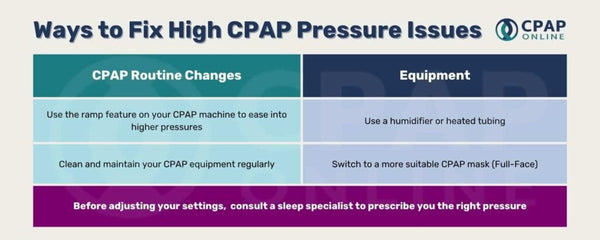
Use the Ramp Feature to Ease into Higher Pressures
Most CPAP machines include a ramp feature, which starts your therapy at a lower pressure and gradually increases to the prescribed setting. This makes it easier to fall asleep, especially if you find higher pressures overwhelming right away.
If you’re not using this feature yet, check your machine’s manual or settings – it’s often one of the easiest ways to improve comfort without changing your pressure prescription.
Consult a Sleep Specialist to Adjust your Settings
When you suspect problems with your CPAP therapy, it is always good to consult a sleep specialist. They can help you figure out if your pressure is set too high and suggest appropriate adjustments. Changes in weight, health or OSA symptoms can sometimes alter your ideal pressure settings. In that case, a specialist can do a CPAP titration study to determine what is best for you.
Consider Switching to an Autoset Machine
If you’re currently using a fixed pressure CPAP machine and experiencing side effects like dryness, air leaks, or difficulty exhaling, there’s a good chance your pressure may be set too high. Fixed machines deliver the same pressure all night, even when your body doesn’t always need it – which could lead to unnecessary discomfort and reduce therapy effectiveness.
One possible solution is to switch to an automatic pressure CPAP machine. These machines use a smart algorithm that monitors your breathing in real-time. They automatically increase the pressure when signs of obstruction appear (like snoring or apnoeas) and reduce it again when your breathing is stable.
Our team of sleep technicians could help with reviewing your therapy data to help fine-tune your pressure settings. One key metric we look at is the N90 pressure, or 90th percentile pressure. This refers to the pressure level at or below which you spent 90% of your night. In other words, it reflects how much pressure your body needed for the majority of the night to keep your airway open.
While the machine doesn’t “target” this number directly, we use it as a guide to set your upper pressure limit. For example, if your N90 is 10.8 cm H₂O, we might recommend having your maximum pressure just above that.
Use a Humidifier or Heated Tubing
High air pressure can dry out your nose and throat. To combat this, try using a CPAP humidifier or heated tubing – both are designed to add moisture to the air and reduce irritation.
Many modern CPAP machines support built-in or add-on humidifiers, and heated tubing helps maintain that moisture throughout the night. This is especially helpful if you suffer from dryness, nasal congestion, or mouth breathing.
Clean and maintain your CPAP regularly
A regular CPAP cleaning routine is an easy way to spot any tears, cracks or small holes that air might be escaping from and causing dryness. It can also help to maintain the seal around your mask, preventing further leaks.
For more information on how to properly clean and maintain your CPAP equipment, read our handy guide.
Switch to a More Suitable CPAP Mask
If all else fails, switching your CPAP mask might be the way to go. Full-face masks are usually recommended for higher pressures as the cushion provides a more secure seal to prevent leaks. They are also great for reducing dryness in those who breathe through their mouth.
Best Full Face Masks For High-Pressure Settings
When buying a mask for high-pressure settings, you want a comfortable, well-fitting mask to ensure a reliable seal and long-time use. With so many available, it can be hard to work out which ones are best. To help, we’ve made a list of full-face masks we recommend for handling higher pressures.

Löwenstein CARA
The Löwenstein CARA mask is a top-tier option for high-pressure CPAP therapy, combining award-winning design with practical comfort. Recognised with the Focus Open International Design Prize in 2018, its lightweight construction and adjustable headgear make it comfortable to wear for the long term. Its silicone mask cushion curves to the face to provide a snug fit and secure seal for effective therapy at higher pressure settings. Available in three sizes (S, M, L) with an optional XL headgear (sold separately), it offers versatile sizing for a stable, leak-free experience for a wide range of users.

ResMed AirFit F30i
The ResMed AirFit F30i represents the new generation of compact full-face masks that provide immense comfort while still providing high-quality CPAP therapy. It can handle a wide pressure range (from 4 to 30 cm H₂O)6, thanks to its UltraCompact cushion that comfortably seals air in. With its plush fabric headgear and adaptive SpringFit frame, this mask ensures stability during your sleep. The AirFit F30i offers five different pack sizes, allowing you to find the best fit.

Fisher & Paykel Evora
The Fisher & Paykel Evora delivers full performance with minimal contact for maximum comfort under high pressures. With a mask cushion made of soft, thin silicone, it sits comfortably under the nose to reduce feeling the pressure. Working in combination with the structured frame, it provides a stable seal. When first trialled, users responded positively to the mask’s seal, with the majority never experiencing leaks into their eyes7. It comes in a range of sizes for cushions (XS, S-M, L) and headgear (standard, XL), ensuring you find the right fit for your face.

ResMed AirTouch F20
The ResMed AirTouch F20 is made for exceptional comfort. A light, breathable seal makes it ideal for users who require high-pressure CPAP settings. Its UltraSoft memory foam cushion conforms to your unique facial contours to create a personalised seal while providing cloud-like comfort. The breathable material is especially well-suited for those with sensitive skin. This mask also offers customisable comfort, with its adjustable frame allowing you to swap the AirTouch F20 cushions (S, M, L) for the AirFit F20 InfinitySeal cushions, depending on what best works for you.

ResMed AirFit F20
The ResMed AirFit F20 is a reliable and comfortable mask for high-pressure CPAP therapy. In ResMed’s internal testing, 86% of users preferred the AirFit F20’s seal compared to the earlier AirFit F108. Designed for comfort, its flexible yet durable silicone InfinitySeal cushion adapts facial movements to maintain a secure fit. This provides enhanced stability at higher pressures. The padded headgear is easy to adjust, and the mask comes in three sizes (S, M, L), making it a good option to meet your therapy needs regardless of your face shape or size.
Signs it’s Time to Consult a Sleep Specialist
If you’re experiencing any of the symptoms we’ve covered – like trouble exhaling, dry mouth, or frequent air leaks – it might be time to speak with a sleep specialist. These professionals have the tools and experience to pinpoint what’s going wrong and can help you adjust your CPAP therapy safely and effectively.
If you’re experiencing any of the symptoms we’ve covered – like trouble exhaling, dry mouth, or frequent air leaks – it might be time to speak with a sleep specialist. These professionals have the tools and experience to pinpoint what’s going wrong and can help you adjust your CPAP therapy safely and effectively.
Remember, your ideal pressure setting can change over time. Factors such as weight gain or loss, new medications, aging, or worsening OSA symptoms can all affect how much pressure you actually need. A sleep specialist can conduct a titration study to determine whether your settings need to be fine-tuned for better comfort and results.
Why You Shouldn’t Adjust Your CPAP Pressure Settings Yourself
Playing around with your settings without talking to a doctor leads to side effects that negatively affect your therapy. In one case from 2011, a 50-year-old man who had used CPAP for four years suddenly lost his hearing9. He had been raising the air pressure on his own as he gained weight and felt his sleep apnea was getting better. Eventually, he set the machine to its highest level. Doctors found that the high pressure caused too much pressure in his middle ear, leading to hearing loss. Extreme cases like this can be easily avoided if you don’t adjust your settings yourself. You should always talk to a healthcare professional since they are equipped to find the proper pressure for you.
CPAP air pressure settings vary from person to person. Your doctor will be able to advise a specific pressure based on your needs, which may change over time. If the setting initially set is too high, you may experience side effects such as difficulty breathing, dryness or leaks. This can do a number on your comfort and the effectiveness of your therapy. By identifying these effects and their impacts, you can take the necessary steps to fix them and consult your doctor about changing your settings. Though finding the best pressure settings for you can take some time to fine-tune, it’s worth it to ensure you get the most out of your treatment.
If you’re looking for ways to enhance your CPAP therapy, check out our blog on Uncle Nicko’s SleepHQ, the sleep platform that helps CPAP patients take real control of their therapy and improve their sleep.

CPAP Online has strict sourcing guidelines and relies on peer-reviewed studies, academic research institutions, and medical journals and associations. We only use quality, credible sources to ensure content accuracy and integrity.
Source 1
McCormick, J. P., Hildrew, D. M., Lawlor, C. M., Guittard, J. A., & Worley, N. K. (2016). Otic Barotrauma Resulting from Continuous Positive Airway Pressure: Case Report and Literature Review. The Ochsner Journal, 16(2), 146. https://pmc.ncbi.nlm.nih.gov/articles/PMC4896658/
Source 2
Shepherd, K., Hillman, D., & Eastwood, P. (2013). CPAP-induced Aerophagia May Precipitate Gastroesophageal Reflux. Journal of Clinical Sleep Medicine, 09(06), 633–634. https://doi.org/10.5664/jcsm.2776
Source 3
Ghadiri, M., & Grunstein, R. R. (2020). Clinical side effects of continuous positive airway pressure in patients with obstructive sleep apnoea.Respirology,25(6), 593–602.https://doi.org/10.1111/resp.13808
Source 4
Devouassoux, G., Lévy, P., Rossini, E., Pin, I., Fior-Gozlan, M., Henry, M., Seigneurin, D., & Pépin, J.-L. (2007). Sleep apnea is associated with bronchial inflammation and continuous positive airway pressure-induced airway hyperresponsiveness.The Journal of Allergy and Clinical Immunology,119(3), 597–603.https://doi.org/10.1016/j.jaci.2006.11.638
Source 5
Stevenson, W. (2023, April 21). Long-Term Side Effects Of CPAP Machine Use - CPAP Info. CPAP Info. https://cpapinfo.net/long-term-side-effects-of-cpap-machine-use/
Source 6
Guide, U. (n.d.).English Français Español Português Device setting Full face. Retrieved June 18, 2025, from https://document.resmed.com/documents/products/mask/airfit-f30i/user-guide/airfit-f30i_user-guide_amer_eng.pdf
Source 7
F&P Evora Full -Prepared by Fisher & Paykel Healthcare. (n.d.). Retrieved June 18, 2025, from https://resources.fphcare.com/content/evora-full-whitepaper-pm-623613.pdf?_gl=1
Source 8
Evolving cushion technology: variable thickness for more comfort and stability. (n.d.). Retrieved June 18, 2025, from https://document.resmed.com/documents/products/mask/airfit-f20/product-guide/airfit-f20_product_guide_row_eng.pdf
Source 9
McCormick, J. P., Hildrew, D. M., Lawlor, C. M., Guittard, J. A., & Worley, N. K. (2016). Otic Barotrauma Resulting from Continuous Positive Airway Pressure: Case Report and Literature Review.The Ochsner Journal,16(2), 146.https://pmc.ncbi.nlm.nih.gov/articles/PMC4896658/


